
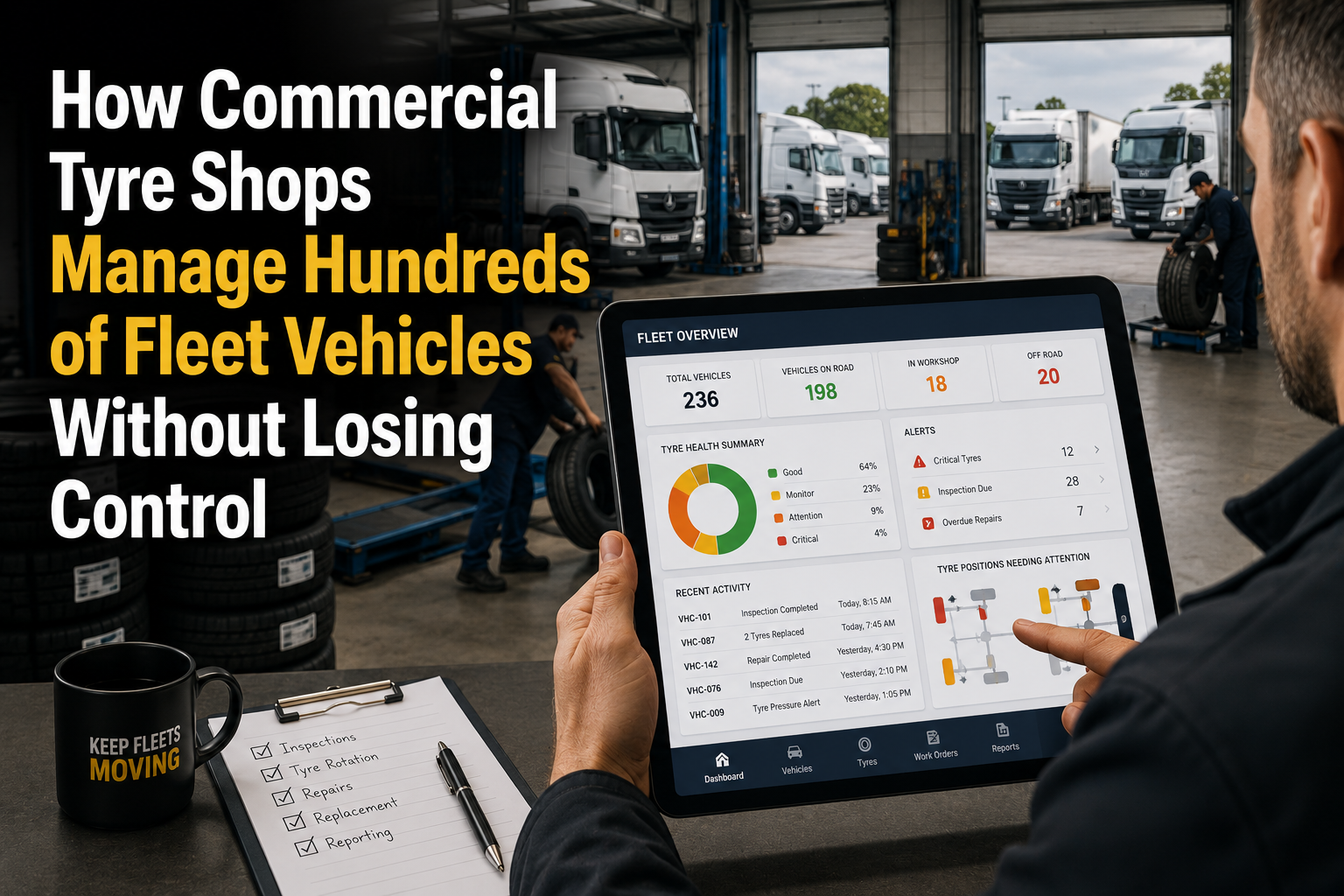
Introduction
Ask most tyre business owners what keeps them awake at night and you'll rarely hear "fitting tyres."
The challenge isn't fitting tyres.
The challenge is managing everything that surrounds the work.
As fleet customer numbers grow, so does the amount of information a tyre business must track.
Vehicle records.
Inspection reports.
Tyre histories.
Work recommendations.
Wheel positions.
Replacement schedules.
What starts as a handful of vehicles can quickly become hundreds or even thousands.
The businesses that continue growing successfully aren't necessarily fitting more tyres.
They're managing information more effectively.
Growth Creates Complexity
A tyre business servicing ten fleet vehicles operates very differently from a business servicing five hundred.
With growth comes complexity.
Questions become more frequent:
-
Which vehicles were inspected this month?
-
Which tyres were flagged for replacement?
-
Which technician completed the inspection?
-
What was recommended last visit?
-
Has the customer approved the work?
-
When was that tyre fitted?
When information is spread across paper forms, spreadsheets, emails, and filing cabinets, answering these questions becomes increasingly difficult.
The Visibility Problem
One of the biggest challenges facing growing tyre businesses is visibility.
Technicians often know what's happening in the field.
Office staff know what's happening with customers.
Management knows what's happening financially.
The problem is that this information isn't always connected.
As a result:
-
Work gets duplicated
-
Recommendations get missed
-
Customer enquiries take longer to answer
-
Reporting becomes time-consuming
The larger the business becomes, the more expensive these inefficiencies become.
Fleet Customers Expect Professional Reporting
Commercial fleet customers are becoming more sophisticated.
Many customers now expect:
-
Tyre condition reports
-
Service recommendations
Providing this information manually requires significant administrative effort.
Some businesses dedicate hours each week simply compiling reports.
Others avoid offering detailed reporting altogether because it consumes too much time.
Neither approach scales particularly well.
The Challenge of Vehicle Histories
Imagine a customer calls asking:
"What happened to Truck 143 last quarter?"
Finding the answer should be simple.
However, many tyre businesses must search through:
-
Inspection forms
-
Service sheets
-
Emails
-
Invoices
-
Technician notes
before they can provide a complete answer.
As fleet numbers increase, locating information becomes increasingly difficult.
Businesses that maintain complete digital histories gain a significant operational advantage.
Wheel Mapping Becomes Essential
For many commercial tyre businesses, wheel mapping is one of the most valuable pieces of information they maintain.
Knowing a tyre was fitted to a vehicle is useful.
Knowing exactly where that tyre was fitted is far more valuable.
Wheel mapping helps businesses:
-
Track tyre movement
-
Identify wear patterns
-
Monitor tyre performance
-
Support customer reporting
Without structured systems, maintaining accurate wheel maps becomes increasingly difficult as vehicle numbers grow.
Administration Can Become the Bottleneck
Many tyre businesses discover that growth doesn't always create more fitting work.
Sometimes it creates more paperwork.
As customer numbers increase:
-
Reports take longer
-
Records become harder to find
-
More phone calls require investigation
-
More administration staff become necessary
At some point, administrative workload begins limiting growth.
The business becomes less efficient despite increasing revenue.
Successful Businesses Standardise Their Processes
Growing tyre businesses often share a common characteristic.
They standardise.
They standardise:
-
Inspections
-
Reporting
-
Record keeping
-
Customer communication
-
Vehicle histories
Standardisation reduces mistakes and improves consistency.
It also makes training new staff significantly easier.
Digital Systems Create Scalability
The most successful fleet tyre businesses understand that information is an asset.
When information is captured consistently and stored centrally:
-
Records become searchable
-
Reporting becomes faster
-
Customer enquiries become easier
-
Historical information becomes accessible
Instead of relying on individual staff members to remember details, the business develops a reliable system.
This allows growth without creating administrative chaos.
Customer Experience Matters
Fleet customers are not simply paying for tyres.
They're paying for service.
Part of that service is confidence.
Customers want confidence that:
-
Recommendations are accurate
-
Records are complete
-
Information is available when needed
-
Their fleet is being managed professionally
Businesses that provide this level of visibility often build stronger long-term customer relationships.
Signs Your Business Is Losing Control
Many growing tyre businesses experience warning signs such as:
-
Staff spending excessive time searching for records
-
Increasing reporting workload
-
Customer requests taking longer to answer
-
Duplicate data entry
-
Inconsistent inspection processes
-
Difficulty tracking vehicle histories
These issues are often symptoms of growth outpacing existing systems.
Conclusion
Managing hundreds of fleet vehicles is not simply a tyre fitting challenge.
It is an information management challenge.
The businesses that scale successfully are usually the ones that develop systems for capturing, organising, and reporting information efficiently.
By improving visibility, standardising processes, and maintaining accurate records, commercial tyre businesses can continue growing without losing control of their operations.