
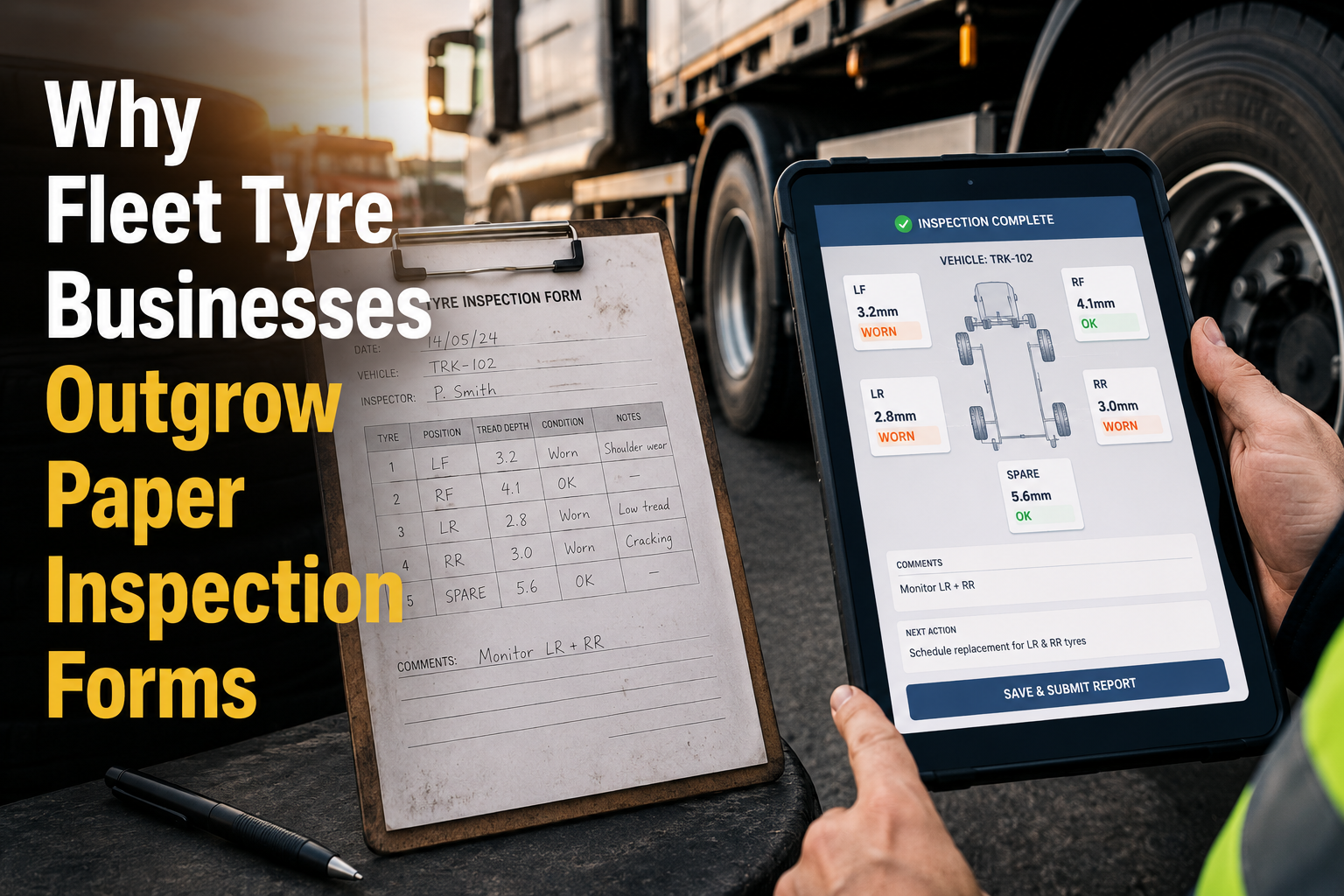
Why Fleet Tyre Businesses Outgrow Paper Inspection Forms
Introduction
Paper inspection forms have been a staple of the tyre industry for decades.
They are simple, inexpensive, and familiar. Most tyre technicians can complete them quickly, and many fleet customers have become accustomed to receiving inspection sheets attached to service reports.
For a small tyre business with only a handful of fleet customers, paper can work reasonably well.
The challenge begins when the business grows.
As vehicle numbers increase, inspection volumes rise, and customers demand better reporting, paper forms often become a bottleneck that limits efficiency, visibility, and customer service.
Many successful fleet tyre businesses eventually discover that the problem isn't completing inspections.
The problem is managing the information afterwards.
The Real Cost of Paper Inspections
At first glance, paper inspection forms appear inexpensive.
A clipboard, a printed sheet, and a pen cost very little.
However, the true cost of paper isn't the form itself.
It's everything that happens after the inspection is completed.
Consider a typical workflow:
A technician completes an inspection.
The paperwork returns to the office.
An administrator reviews the information.
The findings are entered into another system.
Reports are prepared.
Customers are notified.
Records are filed for future reference.
Each step consumes time.
Each step introduces opportunities for mistakes.
Each step increases administration costs.
Information Gets Trapped on Paper
One of the biggest challenges with paper inspections is accessibility.
Once an inspection has been completed, the information often exists in only one place.
A physical piece of paper.
If a customer calls asking:
-
What tread depth was recorded last month?
-
When was that tyre replaced?
-
Which wheel position had the damage?
-
What recommendation was made during the previous service?
Someone usually needs to locate the paperwork manually.
As customer numbers increase, this process becomes increasingly difficult.
Fleet Customers Expect Better Visibility
Commercial fleet customers are becoming more data-driven.
They increasingly expect tyre providers to deliver more than just tyre fitting services.
Customers want visibility.
They want to know:
-
Which vehicles require attention
-
Which tyres are approaching replacement
-
Which wheel positions are wearing unusually
-
What work has been completed
-
What recommendations have been made
Providing this information from paper records can become a major administrative burden.
Many tyre businesses spend hours every week building reports that customers now expect as standard.
Paper Makes Trend Analysis Difficult
A single inspection provides a snapshot.
Multiple inspections reveal trends.
Those trends are often where the real value lies.
For example:
A tyre fitted six months ago may appear healthy today.
However, when compared with previous inspections, it may show accelerated wear.
A fleet vehicle may repeatedly show damage on the same wheel position.
An inflation issue may affect multiple vehicles within a fleet.
These patterns are difficult to identify when information is scattered across folders and filing cabinets.
The Challenge of Growth
Many tyre businesses experience a similar progression.
At first:
-
Five fleet customers are manageable.
-
Ten fleet customers are manageable.
-
Twenty fleet customers are manageable.
Then suddenly:
-
Hundreds of vehicles
-
Thousands of tyres
-
Multiple technicians
-
Growing reporting requirements
The systems that worked when the business was smaller begin to struggle.
Owners often find themselves hiring additional administrative staff simply to keep up with paperwork.
The problem is not necessarily the volume of inspections.
The problem is managing the information generated by those inspections.
Lost Paperwork Creates Risk
Every paper-based process carries risk.
Inspection sheets can:
-
Be misplaced
-
Be damaged
-
Become difficult to read
-
Be filed incorrectly
-
Go missing entirely
When this happens, valuable historical information can be lost.
This becomes particularly important when customers question recommendations or request historical records.
Accurate records protect both the tyre business and the customer.
Digital Inspections Change the Workflow
Digital inspection systems remove many of these challenges.
Instead of writing information onto paper and processing it later, technicians record information directly into a digital system.
Inspection results become immediately available.
Vehicle histories update automatically.
Reports can be generated instantly.
Recommendations are stored permanently.
Most importantly, information becomes searchable.
Instead of searching filing cabinets, staff can access vehicle records within seconds.
Better Reporting Creates Better Customer Relationships
Many tyre businesses compete on service rather than price.
Reporting can become a significant competitive advantage.
Customers appreciate providers who can clearly demonstrate:
-
Tyre condition
-
Work completed
-
Replacement forecasts
-
Historical trends
-
Cost-saving opportunities
Providing professional reports helps reinforce the value of the service being delivered.
It also reduces the likelihood of customers viewing tyre work as simply a commodity.
Digital Records Support Business Growth
As businesses grow, consistency becomes increasingly important.
Digital systems help ensure that:
-
Inspections follow standard processes
-
Information is captured consistently
-
Records remain accessible
-
Reporting remains scalable
Rather than adding administration staff to manage increasing paperwork, businesses can focus on growing revenue and servicing additional customers.
Signs Your Business Has Outgrown Paper
You may have outgrown paper inspection forms if:
-
Technicians complete large numbers of inspections each week
-
Customers regularly request historical information
-
Reporting consumes significant office time
-
Paperwork is frequently misplaced
-
Multiple staff require access to the same records
-
Vehicle histories are difficult to locate
-
Fleet customers expect more detailed reporting
These challenges often indicate that existing processes are becoming a barrier to growth.
Conclusion
Paper inspection forms have served the tyre industry well for many years.
However, as fleet customer expectations increase and businesses continue to grow, paper-based systems often become difficult to manage efficiently.
The issue isn't collecting inspection data.
The issue is turning that data into useful information that improves customer service, supports decision-making, and helps the business scale.
For many growing fleet tyre businesses, moving beyond paper is not simply a technology upgrade.
It's a business growth decision.